
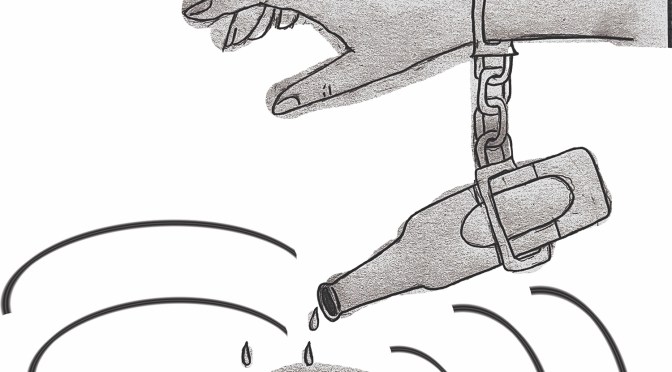
Children are left to carry the weight of their father’s actions–two dead as a result
By Trevor Ing, Editor-in-Chief
“My dad is a murderer.”
Those words were uttered by the oldest daughter of a staff member here at the high school the day she learned about the accident.
Maddie Freeder talked about how she and her two siblings now have to live knowing their father made the decision to get behind the wheel after having a few drinks, and according to police records, “an unknown substance,” which resulted in the deaths of two innocent people.
On an average Sunday afternoon in December, in the southern part of the U.S., an elderly couple was traveling north on the interstate, dreams ahead of them, when they were forced off the road by an impaired driver and crashed into a tree. As emergency crews arrived on the scene, both were pronounced dead—the woman was so mangled that she was unable to be identified until later tests were performed.
That driver was Mark Freeder–an addict–who supposedly had been sober for two years, according to Maddie.
Just this past November, Mark visited his family in Ohio and proclaimed even then that he was sober; however, that day, Mark got behind the wheel with “two times the legal limit of alcohol” according to a local news source who interviewed the lead trooper on scene.
The trooper went on to say the whole situation was “a ridiculous mistake.” This “ridiculous mistake” was not so ridiculous to the three kids who call Mark their dad: Maddie, the oldest; Gabriel Freeder, the middle child and Charlotte Freeder, the youngest. The three of them now have to deal with the repercussions their father made that fateful day–a mistake that still seems unreal to each of them.
“You hear about it happening in the news, but you don’t think it’s ever going to be someone you know,” Gabriel said, and he certainly did not think it would be one of his parents.
Much earlier in life before the accident, while still trying to stay in his kids’ lives, Mark struggled with addiction. While married to his then wife and teacher, Annie Freeder, he would commonly drive to his parents’ house immediately after work, where he would either drink or partake in other drugs before going home.
“[Mark] was not permitted to do any of that stuff in our house…[The kids] clearly knew something was wrong with him,” Annie said. “He would be passed out on the couch, and I would make the excuse that he had a hard day at work or whatever I came up with to try and shield them from the truth, but alcohol wasn’t an issue back then–that came after the divorce. He did a lot of other things though, many of which I didn’t discover until later.”
After covering for Mark so many times, Annie finally reached a breaking point with what the kids called “the final fight,” which became the reason he was forced out of the home, and the divorce immediately followed.
After he moved out, Mark became the “fun dad.” He moved in with his parents and was given every other weekend to spend time with his three kids–most of which he took.
While the kids enjoyed being with their father, there were often times when his addiction got in the way of regular visits, and at one point the kids were taken away from him for about a year after he was caught doing drugs when eight-year-old Gabriel was with him.
“[My dad] straight up did bath salts one night when he was watching me,” Gabriel said.
After that incident, Mark seemed to be handling his addiction better and went back to his regular schedule for visitation, and as the kids got older, it was evident the two houses were very different: One with rules and one without.
“You had so much freedom… He rarely said no to stuff,” Gabriel said.
Charlotte, too, recalled the differences between the two houses: “I remember favoring my dad’s house more than my mom’s because there was such a lack of structure [at his house].”
Even though he might have given too much freedom at times, he still was able to hold a good connection with his kids early on. With Maddie, he became the parent to which she would always go, as she and Annie did not always see eye-to-eye; as a result, Maddie moved in with a friend in April of her senior year of high school.
“[My dad has] always been super supportive of me and honestly, despite what happened, he’s a really good guy. I just remember all the kindness and life lessons I’ve learned and being a good person has all been from him,” Maddie said.
Toward the beginning of Gabriel’s senior year of high school, he moved in with his father after having complications with his mom’s house rules. Unlike Maddie, Gabriel found that he did not have someone he could talk to about life, and things were very different than what he expected, so after a couple of months, he moved back in with Annie.
“I knew that Mom would support me better. I was starting to enter college and stuff and my dad didn’t know [crap] about it,” Gabriel said. “I think at that point I was realizing, ‘Hey, you know, having total freedom isn’t actually all it’s cut out to be…It’s nice having a support system and parents who actually [care] about you.’”
At only three and a half years olf when the separation occurred, Charlotte had good memories attached to her father. Although remembering vividly the whole “final fight,” she kept a decent relationship with Mark.
“I just remember him having a fun time with me [when I was little]. We went to the lake, he taught me how to ride a bike, he taught me how to shoot a gun, he got me into archery and he let me play video games and stay up as long as I wanted,” Charlotte said. “I just remember it being a very free environment.”
After Mark’s accident, Maddie was the first to know, learning about it a few days later: “My grandpa called me Tuesday morning and was like ‘We waited a couple days to tell you, but your dad’s in jail and he drove drunk,’ and I was just like okay whatever.”
Gabriel said that Mark was involved in many accidents before, so at the start of Maddie’s conversation with her grandfather, it was not much of a surprise to her hearing he was involved in another accident, but this situation was different from the rest.
“Then he said, well, he killed two people in that accident. I was in my office with a coworker, so I was trying to hold it together. Then all I kept thinking about was getting over to their house, so I left work,” Maddie said.
On the drive to her grandparents’, she started calling her siblings to let them know about the situation. Charlotte was the first one Maddie was able to reach, but Gabriel was still asleep due to his third-shift job, which has him on opposite hours from everyone else. It was Gabriel’s wife, Sarah, who ended up telling him.
When Sarah got home, she immediately woke Gabriel up to tell him about the incident, but she wanted to tell him outside of their house as to “not connect bad memories to [their home].” Gabriel immediately assumed someone had died, so when Sarah told him what happened, he was somewhat relieved.
“She told me, and the first thought I had was like, ‘Oh thank God it wasn’t something worse,’” Gabriel said. That was until he found out about the elderly couple whose lives were lost in the crash.
“Honestly, my dad’s like a cockroach. He’s totaled every car he’s ever owned [because of his addiction] and walked away relatively unscathed every time. The worst part for me was the fact that innocent lives were taken,” Gabriel said.
Initially he was not too surprised because of how common the situation was with Mark. For Charlotte, things were not as relieving.
“I was silent for a solid 45 seconds because I was just processing. ‘Am I still sleeping and what are we talking about? There’s no way,’” Charlotte said.
After some time, the kids were able to come to terms with what happened. They understand they can not change what happened, but now they are weighed down with the possibility of not being able to see their father for 20-30 years. Maddie in particular said she finds it hard to have some sort of closure until after he is sentenced.
Ironically, Maddie and Gabriel both work with people just like Mark. She is a chemical dependency therapist and Gabriel works as a corrections officer at a correctional institution.
With Maddie’s help, Mark had the opportunity to go through five rehab facilities–the most recent one costing $45,000. Maddie was able to get him a scholarship through her job.
After this final rehab, he told his entire family and employer that he was free from his addiction to drugs and alcohol. Before the incident happened, Mark moved down south with intentions to “start fresh.” He had a job working for maintenance that he got through someone he knew, and he had an apartment.
Similar to the result of his previous rehabs, Mark relapsed, and now he faces the consequences of his addiction–real jail time for killing two people.
According to The National Library for Medicine, “Studies show that more than 85% of individuals relapse and return to drug use within one year of treatment,” meaning, Mark’s situation was not out of the ordinary, especially from Maddie’s perspective.
“It’s understandable. I’ve been in the field for nine years, and I just come to expect it,” Maddie said.
Even though it was not a surprise, Maddie struggles to find any forgiveness.
“I can respect that he’s my dad, and I obviously love him because he’s my dad, but [my] respect for him as a person is kind of gone,” Maddie said. “I just can’t respect or have someone in my life who chooses to do that, and now there’s a whole family grieving.”
Sadly with addiction, there is a lot of stigma from the public. People post on social media making fun of addicts in the streets, doing what they like to call the “fenty fold,” and then being disgusted when they try to get help. It may be funny to some, but to others who have to live through the situation, it hurts them knowing these people are essentially talking about their family members.
“When you have an [addicted person], they are a human being with a real life… Almost every [addict] I’ve worked with has been the best human ever,” Maddie said.
All three children went to their mom’s the day they found out and were most bothered by the FaceBook posts they read about their father. While they realize Mark is the one solely responsible for these two deaths, they were hurt at how nasty some of the comments were. Charlotte seemed the most upset and commented how “some of these [addicts] have children” who are reading these threads.
Addiction does not just affect the addict’s life–it causes a ripple effect that hurts all others around them. In Mark’s case, his addiction spread to Annie in a much different way than the rest of the family.
“I don’t know how to help [my kids]. I think that bothers me the most because I’ve always protected them, and as a parent, you want to protect your kids, and you don’t want your kids to hurt, but this is something that is beyond my knowledge scope,” Annie said. “I’ve always been a fixer, and I can’t fix this. They will never be able to say anything other than ‘My dad is a murderer,’ and that is hard to think about as a parent.”
Addiction is simply a chemical imbalance in the brain, as Maddie put it, and it has a lot to do with genetics. People with high perceptibility to addiction can go from being completely normal to all of a sudden being completely addicted to whatever they are taking. It varies from person to person, but addiction can start on the first or the 100th beer a person has; unfortunately, getting help most of the time is much harder than it should be.
On average, rehab can cost anywhere from $30,000-$70,000, where there is only a 25% chance the patient actually succeeds according to The American Addiction Center. Although these programs exist, they seem so far out of reach for most addicts.
“I definitely think a lot of good things come from rehab programs, but they are prohibitively expensive. Like why are we charging people $60,000 to help them? It just makes no sense,” Gabriel said.
Annie and her children were all adamant that addiction treatment can not keep going on like it is. In 2023, there were 12,429 alcohol-impaired driving fatalities in the United States, averaging about 34 deaths per day or one person every 42 minutes, the NHTSA said. These numbers are from real people, from people with futures and most importantly, from people with families. Along with the deaths, addicts are not only putting themselves, but others in danger each time they get behind the wheel.
Hotline numbers like 988 are out there for anyone struggling with substance abuse. “Whether you’re facing mental health struggles, emotional distress, alcohol or drug use concerns or just need someone to talk to, our caring counselors are here for you. You are not alone,” 988Lifeline.org stated.
“If you suspect someone is struggling with a substance, don’t shy away from it or beat around the bush with it. Just ask them directly. Tell them how you feel–ask them if they’re doing okay. Ask them if they know what they’re doing because if you ignore that stuff, you get people like my dad, who will do something really stupid and then other people end up getting hurt because of it,” Gabriel said.


 SEE SOMETHING, SAY SOMETHING--Anyone can call the tip line: 1-844-723-3764 or email safehs@smfschools.org