


Girls’ Basketball vs Brecksville-Broadview Heights 1/23
Phone ban
Living with an unknown mental disorder
Personal Narrative
By Zoey Davis, Editor
In 2021, I was going into seventh grade. I had no friends; I had lost touch with my old friends over the summer because of conflicts and growing apart. I felt very lonely and embarrassed, and everyone had already built their own friend groups.
I experienced extreme worry and self-consciousness walking into school, being in class and sitting alone at lunch. I had only a few people I would talk to, and none of them on a personal level.
As school continued, people started to talk to me. A girl who sat beside me in my science class complimented my makeup. This same girl sat behind me in the homeroom, as we had similar last names. She introduced me to her friend group. I finally made friends of my own after losing all my previous ones.
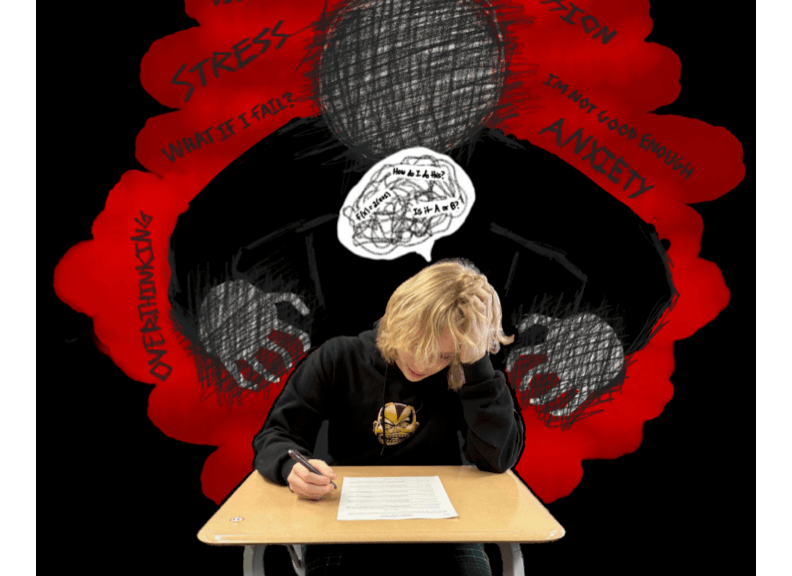
Throughout seventh grade, I noticed I would get awful stomachaches and horrible anxiety. In turn, I started talking to the guidance counselor at Kimpton and spending more time in the nurse’s office. I spent months complaining about the stomachaches I was having, how they affected my sleep, my appetite and my ability to even get up some days.
After a few months of missing school days and spending back-to-back periods in the nurse’s office, my mother finally scheduled a doctor’s appointment. My doctor told me it was probably just normal anxiety and that it would pass.
I continued feeling this anxiety and extreme pain in my stomach until freshman year. My condition got worse, and I dealt with harsher anxiety, more stomachaches, heartburn and even shakiness in my legs. I was put on anxiety medication and medicine for both heartburn and stomachaches.
My condition stayed constant, and I started experiencing extreme anxiety attacks. There were days when I couldn’t even get out of bed–I was stuck in pain. The medication they had me on wasn’t working, including my pain medication. I started using larger amounts of Ibuprofen, amounts that would surely kill my liver. I completely abandoned my prescribed medications, filled with rage about the ineffectiveness of the medication.
There were many days I struggled with the motivation to get out of bed, grappling with the mental and physical frustrations. I felt too anxious or sick to get up, too overwhelmed by even everyday tasks. Other days, starting an assignment, cleaning my room or something as simple as talking with friends, felt like an impossible task to complete.
I felt as if no doctors were listening to me; every doctor’s appointment felt the same. Between Psychologists, Gastroenterologists, MFM’s, Neurologists, Cardiologists and Immunologists, I felt hopeless. Doctors kept ordering tests. I’ve gone through MRIs, scopes, brain tests, asthmatic tests and blood tests, and I continued to receive the same news, regardless of the specialists to whom I went.
Fortunately, I was finally given one diagnosis among all those doctors and tests: Functional Neurological Disorder, also referred to as FND. Unfortunately, research on this disorder is scarce, and there isn’t much I can do to help with the diagnosis. FND is a disruption in the brain and body; simply put, my brain is sending signals to my body that it isn’t supposed to be doing.
I went through therapy to try and help my symptoms, ways I could ‘calm’ myself down when experiencing an ‘attack.’ Therapy did nothing for me, as there was no reason why I was having these symptoms. I couldn’t calm myself down when experiencing a symptom, as I wasn’t anxious, and it happened all the time. Again, my condition dwindled to anxiety.
I got angry about being diagnosed with no resolution, at therapy being a waste of time, at doctors for not listening to me and for being taken on and off medications I couldn’t even be on long enough to remember. I stopped taking all my medications and stopped going to therapy and doctors’ appointments. I gave up on my health, deciding to just work through it.
When you lose the complete motivation and physical capability to do most things, this also includes personal hygiene. Recently, I’ve been getting better at keeping up with my hygiene, but in earlier years, it was shameful. I was very embarrassed and riddled with guilt at the state I was in most days.
I had days and weeks without showering, brushing my teeth and hair, etc. On days when it was physically impossible for me to get out of bed, my hygiene was the least of my concerns. Days where even just changing my clothes would be considered a win, showering seemed so far away.
My attendance also suffered immensely; I went the whole school year of my sophomore year without going a full week once, sometimes missing an entire week. My relationships also suffered with my friends and family. I stopped hanging out with friends, feeling too ill to go or stopped full communication. I felt as if my family couldn’t understand, that they didn’t believe me–I had arguments about my attendance, my social life and even my own condition.
I felt isolated, so I started throwing myself into my school work. I figured if I had anything, it would be education. I tried so hard to keep up with my classes, making up work as fast as I could, or studying harder to make up a test in two days. I achieved my goal; I ended my sophomore year with a 4.3 GPA, although I had 200 absent hours, not including medical absences.
Going into junior year, my stomachaches became less of an issue, and heartburn turned to once a month. Although new issues arose, the shakiness in my legs became worse, my heart rate was elevated above normal rates, and I couldn’t go a day without feeling like I was about to pass out. The shakiness developed into constant pain in my legs. At night, I can remember crying because the pain was so bad I couldn’t sleep.
I had to go back to the doctors; it was all too much to ignore. As I sat down for the first appointment back, I felt listened to, I felt heard. After many visits back, I was also diagnosed with Postural Orthostatic Tachycardia Syndrome, commonly known as POTS. POTS is a cardiovascular disorder that makes my heart jump to high rates and makes me feel lightheaded, dizzy and nauseous.
Anxiety, FND and POTS all share symptoms that can make it difficult for doctors to diagnose, which is why it took my doctors 4-5 years to diagnose me, alongside ongoing health problems that haven’t been properly diagnosed. Chronic illness on top of a mental disorder that makes it hard to function mentally is exhausting.
With the recent diagnosis, I didn’t know how to feel. I felt like it answered some questions but left others unanswered. I was glad for the diagnosis, as it would help my symptoms become more serious and real to others.
Currently, I still suffer from chronic leg pain; I can’t stand up without my vision going blank, and the lightheaded feeling of passing out haunts me every day. I still have many specialists to see just to get some idea of my ongoing health and mental concerns.
I live most of my days in constant worry about my grade, my family, my friends and especially my health. I can feel the strength of my legs deteriorating. I’m scared that one day it’ll get so bad I can’t walk anymore. I live in fear that I’ll never be healthy, and I’ll be stuck on medication for the rest of my life. A life that I thought would never happen to me is closer than I think. Actively feeling my own brain and body work against each other is terrifying.
Girls and Boys’ bowling teams find success despite hardships
By Halah Anwaar, Social Media Manager
Both bowling teams have had a strong season marked by consistent scores and steady improvement. With hard work in practice, translating to results in matches, the team continues to compete with confidence.
With bowling there are specific factors that stand out to individuals, motivating them to keep playing. These interests can vary from person to person and for junior Olivia Kolczynski, who has been bowling competitively for three years.
“Within bowling there are a lot of different types of people, and us as a team definitely get together well. Most teams we compete against are also incredibly kind and supportive. I also like that bowling is a less physical sport and more mental,” Kolczynski said.
With every new season comes different obstacles. The team can push past those obstacles by building resilience, supporting one another, and staying focused on shared goals.
“I would say our biggest challenge this year is focusing. Many of us on the team lose focus fast due to either others on the team or just the general environment of the alleys. We overcome this by making sure we focus on the approach and just zone out the environment by focusing on our mechanics and making good shots,” Kolczynski said.
A type of play the team encounters during the season is something called a Baker game. Baker games are a team format where five players combine to bowl a single 10-frame game, with each player responsible for two frames in a specific rotation. Teamwork is the most important aspect along with skill, but this year, the players are struggling.
“Teamwork is really important. I want to bring back team chants and reactions for strikes and spares to boost morale. We do well individually, but Baker games are where we struggle the most, so improving teamwork there is key,” senior captain Dillin Rogers said.
Growth is a given when working hard. With a sport, growth for an individual as well as for a team can come in various different forms. Senior Olyvia Janka, who has been bowling with the team for the past two years, believes that the team has seen improvement.
“The team has grown to not only bowl better, but also to communicate with each other better and be there for each other,” Janka said.
Boys’ head coach, Paul Tucholski, explained how this season he wants to focus on growing the students to have more confidence in themselves. The bowling team is suffering a bad mental wave where they allow past frames which affects how they play. Tucholski hopes to fix that.
“I want them to listen to the coaches, not what other team members think. I want my team members to always forget what they did in the last frame and focus on doing better in the next one,” Tucholski said.
Along with Tucholski, Rogers agrees there is an issue with team work, stating the problem does not come from dislike of players, but they themselves getting upset which brings down team morale.
“Some players have big egos and get upset about being benched, which affects the whole team,” Rogers said.
Being a team captain can mean a lot of different things. For Kolczynski, it means being a helping hand for her team.
“As a captain, I help organize the team together for matches and tournaments, figure out lineups for bakers and assist in ways the coaches need such as giving advice, going to assist in JV events and just being a reliable person for the team,” Kolczynski said.
Progress can be a key factor to performing better in sports. Players can not only improve upon skills but also in their mindset. Junior Violet Shall believes this has greatly affected their team.
“I see a lot of improvements especially in the structure of the team, last year felt unstructured due to coaching changes and a lack of people. This year we have way more people and everything moves more smoothly,” Shall said.
 SEE SOMETHING, SAY SOMETHING--Anyone can call the tip line: 1-844-723-3764 or email safehs@smfschools.org