Category Archives: Print Editions

Depression’s effect on everyday life 

*A pseudonym will be used to protect a students identity.

     Depression is a mood disorder where a person experiences symptoms of a depressed mood, sadness and loss of interest in daily activities to the point where it affects their normal function such as their appetite, energy levels, concentration levels and sleep. 

    Each person who suffers from depression suffers differently. Everyone experiences symptoms unique to them. Some may have cases of depression whereas some may have severe cases. 

    Sasha Orlando* shared her story and experience with depression.

    “I would say my experience with depression consists of a lot of ups and downs, sometimes my depression is more prominent than other issues I have in my life like my anxiety,” Orlando stated. 

    Depression can take over someone’s entire life. It can severely affect how someone treats others and how they perform in school. A person’s actions are greatly affected by how they feel. 

    “I would say the hardest part of having depression is not realizing that’s what’s currently going on even though I’ve been dealing with depression since I was seven when my dad passed away. It’s still really hard for me to identify when I am depressed,” Orlando explained. 

    Depression can cause moments of haze where someone is not completely aware of the things going on around them or it can cause a person to not care about the things happening around them.

    “It’s so different for other people so it’s really hard to put that into words. I feel like for me personally, prescription medications have never worked for me. I’ve tried so many for years increased and decreased the dosages for so many different things and that has never been something that has helped it always made things worse. It has made me feel like I have no emotions, and I’m a very emotional person, so that’s not normal for me no matter if I’m depressed or not,” Orlando said. 

     Depression can also bring a sense of comfort. For some people, it can be extremely hard to recover because they find comfort in their sadness. Depression can also be something that someone works so hard to get away from but can not. Depression is a very difficult illness to overcome to the point in which some do not overcome it and end up succumbing the their depression.

    “My recovery process might have looked different for other people, and I wouldn’t even say recovery because I still deal with depression every day of my life. It’s not something that goes away. It may get easier, but the thing that helps me the most is being with my mom or being outside.”

    As Orlando explained how her recovery process might look different than other people’s. Everyone’s recovery and depression experience is going to be unique to them. Everybody’s brain is wired differently.

    Orlando talked about how her depression has changed over time. As a person grows their depression and how it affects their daily life and the symptoms it causes changes, too. 

    “I feel like when I was depressed before maybe in the past year and previously I had a really hard time talking to people about it. I didn’t know how to talk about my feelings or why I was feeling this way. I feel like now when I’m depressed, I want to talk about it.  I want somebody to be there for me, but I mean it’s still really hard when you can’t recognize that’s what the issue is,” Orlando stated.

    Orlando’s experience may look similar or very different to others. Orlando’s story might be one some can relate to. Depression can become a very serious illness if not treated. Orlando talked about what did and did not work for her and how similar things may or may not work for someone else. It is all about finding what works just right for a specific person. 

    Recovery is not easy, but it is possible. “Recovery is long and it’s not easy to go through, but it can be done,” Orlando said.

LGBTQ Mental Health

     According to TheTrevorProject 1 in 3 LGBTQ+ kids said their home was LGBTQ+ affirming. This shows how often young kids are not supported in their identities by the people they are surrounded by the most. 

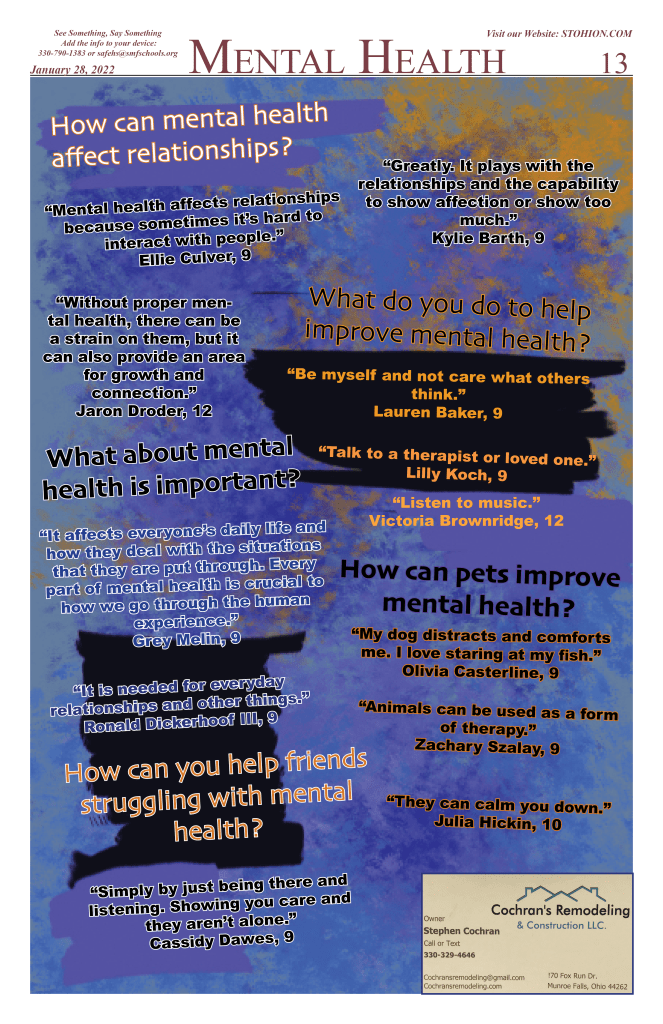
     Mental health has been increasingly critical because of the things this generation has had to go through such as the COVID-19 pandemic, going through high school, and just everyday things that are difficult to process. 

     For LGBTQ+ kids, their mental health has been affected more than heterosexual kids because of the discrimination they face at home, school, or anywhere. Junior at St. Vincent St. Mary’s, Niya Williams, shares her experience being a LGBTQ+ youth. 

     “My experience being in the LGBTQ+ community has been both positive and negative. One being that I have a community of people who don’t know me but love me for who I am no matter what, and two being that people hate me for my identity,” Williams stated. 

     Many in the community find it beneficial to have a community to back them up when they have no one else to turn to. This has helped the mental health aspect of the community prosper to better things despite the discrimination they face. 

     Williams continues by explaining why she thinks mental health is so important in the LGBTQ+ community.

     “Mental health is so serious in the community because of the hate that can be spewed on us in the community. We all have to be there for each other in the process. When others spew hate on those in the community it can cause self hatred, poor self esteem, and sometimes being unable to stay safe from oneself,” Williams expressed. 

     Safety in the community is essential because everyone deserves to feel safe in their own skin. Everyone deserves to love themselves authentically. Williams final thoughts on what she would change about the community to make it a better safe space for all members.

     “I would change not the community itself but how others view the community. People refuse to educate themselves and understand people who are in the newer generation and that has made being in the LGBTQ+ community super hard,” Williams shared. 

     Sophomore at Notre Dame, Leo Herman, shares his experience of being a LGBTQ+ college student. 

     “Luckily for me when I have come out to people I have never had a negative experience. I found myself lucky within those people because they are the people I care about most. I have seen some people have negative reactions to finding out my identity, but it wasn’t anyone I was close to,” Herman said. 

     Negative reactions to someone coming out could definitely make them insecure about themselves and their identity. This would definitely make being in the LGBTQ+ community hard for some because of the negative reactions from people who are close to them. 

     Herman shares his opinion on how well the LGBTQ+ community is portrayed in the media. 

     “ I will never pass up the chance to plug the show ‘Heartstopper’ because I think it portrays a young LGBTQ+ relationship really well. I felt seen within the show, and I think this could benefit others who are unsure of their identity,” Herman affirmed. 

     Seeing people on TV who have the same identity as those in the community can be super affirming for those not able to express themselves. It can definitely boost confidence in those who have not seen themselves before, and this can positively affect mental health for those in the community as well. 

     Herman finishes his statement by explaining the necessity of mental health resources for LGBTQ+ youth. 
     “There are some really good mental health resources including but not limited to The Trevor Project. They have done so much for the LGBTQ+ teens, but there could definitely be other organizations that deal with mental health that I don’t know about. Everyone deals with mental health differently so there could always be a different way to approach it for someone else,” Herman expressed. 
     Sophomore at Ohio State University, Laura Powers, shares her experience with supporting the LGBTQ+ community. 

     “It helps that OSU is such a big school and it is very accepting. There probably are some people who aren’t, but the school as a whole is very accepting. They have clubs and they have a process for housing that makes everyone feel included,” Powers shared. 

      It is very important to make inclusive clubs and spaces for students to feel as though they belong somewhere. They may have so many other places that do not feel safe, but that one safe space could make the biggest difference. 

     Powers resumes with how some have viewed the community negatively because of their opinions. 

    “I have never heard anyone say anything negative about the community personally, but I have heard stories about what people have been through. It is horrible, but I hope in the future it gets better. It should be more accepted, but I know for some it is hard to come to terms with a new reality,” Powers expressed. 

     When people have negative opinions about someone or something they can have a healthy conversation about it. It doesn’t have to be an argument and they don’t have to be rude about it. This could lead to better mental health for everyone in the community if we talked with kindness instead of hate. 

     Powers last words showed how powerful it is to have mental health advocacy in this generation. 

     “Talking about mental health within the community is normal to this point because of how much discrimination the community faces on a regular basis. If more people were to talk about the situations they handle everyday it may help someone else on their journey to better themselves,” Powers affirmed. 

     Every one of these people have had a different experience with the LGBTQ+ community and although they are talking about the same community they have all had unique situations. These stories may have an effect on someone, and that someone may figure out who they are and the ways they need help.      If you or a loved one is suffering from mental health, call or text 988 and for LGBTQ+ kids the Trevor Lifeline is 1-866-488-7386.