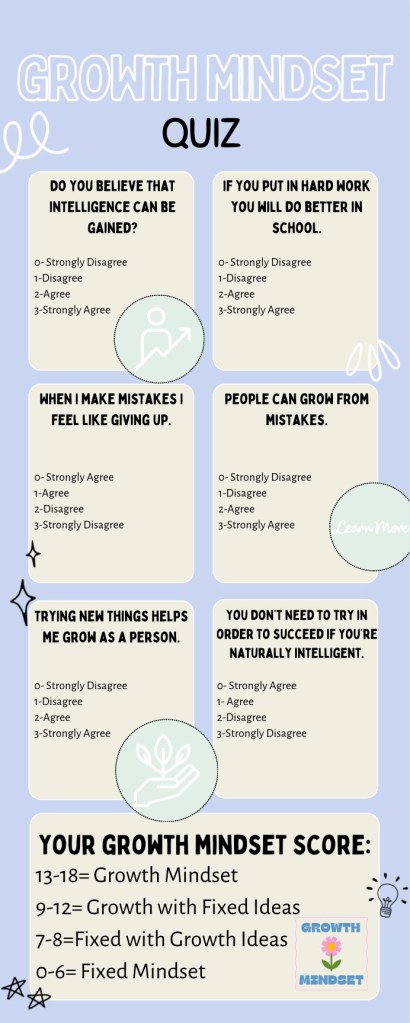
Growth Mindset Infograph

You may be going through school complaining about math or english class saying things like, “I’m just not good at it,” or “I’ll never get better at this.” If you find yourself thinking these things you may have a fixed mindset.
People who possess a fixed mindset may believe that people are born with talent or intelligence and if you aren’t naturally gifted at something, even with practice, you never will be.
On the other hand, having a growth mindset means you believe that working hard to develop more intelligence or talent is possible. This mindset helps people become more successful since they try to make progress toward becoming better.
According to Mindsetworks.com, recent neuroscience research shows that what we once thought of as unchangeable traits are changeable with persistence, training, and learning from your mistakes and we can increase neural growth by the choices we make.
Developing a growth mindset is vital to expanding your interests, discovering new passions, and growing as a person. You may be wondering if you have a fixed or growth mindset and although it seems people are one or the other the truth is that there’s a spectrum of mindsets.
Another common misconception about growth mindsets is that having a growth mindset is just having a positive outlook on life. Although it seems like it, this notion is not true. Obtaining and maintaining a growth mindset means you have to put in time and effort, as well as be able to embrace failure as part of the learning process to grow from it.
As biglifejournal.com states, “…concepts like neuroplasticity, which explains that the neural pathways in the brain are constantly changing in response to our experiences–the more you practice, the stronger the brain becomes, and the more automatic the process.”
To start improving your mindset try to understand where you fall in the spectrum with a growth mindset quiz. Set goals for yourself then start taking steps to improve. For example, you can really make a difference if you change the way you talk about your own skills.
Changing sentences from, “I don’t know,” to “I’d like to learn,” and “I’m not good at this,” to “ I may not be great at this right now but practice can help me become better,” is a great way to start improving your mindset. After a difficult task try asking yourself what you could do differently to improve for next time. Having the desire to learn and put in effort to improve yourself and your life can help you become more successful in school and life in general.
According to TheTrevorProject 1 in 3 LGBTQ+ kids said their home was LGBTQ+ affirming. This shows how often young kids are not supported in their identities by the people they are surrounded by the most.
Mental health has been increasingly critical because of the things this generation has had to go through such as the COVID-19 pandemic, going through high school, and just everyday things that are difficult to process.
For LGBTQ+ kids, their mental health has been affected more than heterosexual kids because of the discrimination they face at home, school, or anywhere. Junior at St. Vincent St. Mary’s, Niya Williams, shares her experience being a LGBTQ+ youth.
“My experience being in the LGBTQ+ community has been both positive and negative. One being that I have a community of people who don’t know me but love me for who I am no matter what, and two being that people hate me for my identity,” Williams stated.
Many in the community find it beneficial to have a community to back them up when they have no one else to turn to. This has helped the mental health aspect of the community prosper to better things despite the discrimination they face.
Williams continues by explaining why she thinks mental health is so important in the LGBTQ+ community.
“Mental health is so serious in the community because of the hate that can be spewed on us in the community. We all have to be there for each other in the process. When others spew hate on those in the community it can cause self hatred, poor self esteem, and sometimes being unable to stay safe from oneself,” Williams expressed.
Safety in the community is essential because everyone deserves to feel safe in their own skin. Everyone deserves to love themselves authentically. Williams final thoughts on what she would change about the community to make it a better safe space for all members.
“I would change not the community itself but how others view the community. People refuse to educate themselves and understand people who are in the newer generation and that has made being in the LGBTQ+ community super hard,” Williams shared.
Sophomore at Notre Dame, Leo Herman, shares his experience of being a LGBTQ+ college student.
“Luckily for me when I have come out to people I have never had a negative experience. I found myself lucky within those people because they are the people I care about most. I have seen some people have negative reactions to finding out my identity, but it wasn’t anyone I was close to,” Herman said.
Negative reactions to someone coming out could definitely make them insecure about themselves and their identity. This would definitely make being in the LGBTQ+ community hard for some because of the negative reactions from people who are close to them.
Herman shares his opinion on how well the LGBTQ+ community is portrayed in the media.
“ I will never pass up the chance to plug the show ‘Heartstopper’ because I think it portrays a young LGBTQ+ relationship really well. I felt seen within the show, and I think this could benefit others who are unsure of their identity,” Herman affirmed.
Seeing people on TV who have the same identity as those in the community can be super affirming for those not able to express themselves. It can definitely boost confidence in those who have not seen themselves before, and this can positively affect mental health for those in the community as well.
Herman finishes his statement by explaining the necessity of mental health resources for LGBTQ+ youth.
“There are some really good mental health resources including but not limited to The Trevor Project. They have done so much for the LGBTQ+ teens, but there could definitely be other organizations that deal with mental health that I don’t know about. Everyone deals with mental health differently so there could always be a different way to approach it for someone else,” Herman expressed.
Sophomore at Ohio State University, Laura Powers, shares her experience with supporting the LGBTQ+ community.
“It helps that OSU is such a big school and it is very accepting. There probably are some people who aren’t, but the school as a whole is very accepting. They have clubs and they have a process for housing that makes everyone feel included,” Powers shared.
It is very important to make inclusive clubs and spaces for students to feel as though they belong somewhere. They may have so many other places that do not feel safe, but that one safe space could make the biggest difference.
Powers resumes with how some have viewed the community negatively because of their opinions.
“I have never heard anyone say anything negative about the community personally, but I have heard stories about what people have been through. It is horrible, but I hope in the future it gets better. It should be more accepted, but I know for some it is hard to come to terms with a new reality,” Powers expressed.
When people have negative opinions about someone or something they can have a healthy conversation about it. It doesn’t have to be an argument and they don’t have to be rude about it. This could lead to better mental health for everyone in the community if we talked with kindness instead of hate.
Powers last words showed how powerful it is to have mental health advocacy in this generation.
“Talking about mental health within the community is normal to this point because of how much discrimination the community faces on a regular basis. If more people were to talk about the situations they handle everyday it may help someone else on their journey to better themselves,” Powers affirmed.
Every one of these people have had a different experience with the LGBTQ+ community and although they are talking about the same community they have all had unique situations. These stories may have an effect on someone, and that someone may figure out who they are and the ways they need help. If you or a loved one is suffering from mental health, call or text 988 and for LGBTQ+ kids the Trevor Lifeline is 1-866-488-7386.
 SEE SOMETHING, SAY SOMETHING--Anyone can call the tip line: 1-844-723-3764 or email safehs@smfschools.org