Category Archives: Front/Home

Does the public have the right to know victims: the people behind the story

By: Ty Phillips/Editor

People become victims everyday. From sexual abuse to domestic violence, there are always people who are living their worst day. 

     The knowledge that people have been through horrible experiences makes people morbidly curious. ‘What did they go through?’; ‘What were they thinking?’; ‘How were they treated?’ With social media people hear something terrible and have question after question. 

     It often seems as if people are forgetting that the “stories” they are listening to came from real people. Recently, I saw students from Central Visual and Performing Arts High School talk about their experience surviving a school shooting in 2022. Over 20 people have come forward to talk about how terrifying it was and how scared they were. 

     To my absolute shock, all I saw in the comments were people asking for part two, making insensitive comments and not many people giving any sympathy. Most of the comments were filled with reaction pics and “Oooooh when we gonna get the rest of the story?” as if what they were listening to was fictional and there for their entertainment. 

     With the Epstein files I am seeing this more and more–people feel like they should be able to know who the people are, how old they were when it happened and everything they went through. People are treating the victims like a show.

     It seems as if people are quickly forgetting that what they find ‘entertaining’ is what others are having nightmares from. Amanda Knox talks about this in her article, “True crime fails when it treats trauma as entertainment. But there’s a better way.” She discusses how society finds brutal murders and true crime to be the peak of their interest without taking into account that it actually happened to someone. 

     While morbid curiosity is normal and important, there becomes a point where it becomes insensitive and rude. Sharing photos of crime scenes and un-blurring photos of the children in the Epstein files is not acceptable or normal. Treating victims with the respect they deserve is happening less and less; They are becoming spectacles for people to talk about.
    Many articles are being written, and there are photos shown of things that victims had to go through, yet it seems as if people are not focusing on the victims themselves but the circumstances and the monstrosities they went through.

     Documentaries are often made about what victims went through. A newer one is Piper Rockelle and what she went through with childhood exploitation and how terribly her mother treated her. While it was airing, people on her TikTok had very little empathy, leaving comments like, ‘Yes, but did she have to do…..” or “Do you guys think she acts like this because her mom made her?” When Rockelle would come on social media and talk about how the documentary–which was made without her consent–affected her, people told her to move on and to just answer their questions. 

     Social media and TV are heavily adding to people’s greed to know what people have been through, desensitizing them to the fact that they have no right to know how people have lived. 

     The Epstein files have left people with many questions. Something I am seeing often asked is why are victims being unblurred, but the perpetrators are being hidden? This leads to more questions about the victims, trying to find them and trying to see if there was anyone who loosely looked like them hanging around celebrities. 

     People are reading what victims had to go through and being disgusted, yet they continue to share it and investigate more. Even when victims of Epstein and similar events come out and ask people to be kinder, not to talk about them like they are a spectacle and give them the respect they deserve, people continue on to act as they did previously. 

     Morbid curiosity is fine, but think about what if one day your family had a horrid murder or attack, and before people ask how you are feeling or what they can do to help, they are sharing all of your private information for everyone to know without asking you for as little as an okay. How would that make you feel? Be considerate and respectful when listening and learning about what people have gone through. `

AI technology raises concerns over water usage

By Carlee Ecklund/Staff Writer

     “A medium-sized data center can consume up to roughly 110 million gallons of water per year for cooling purposes, equivalent to the annual water usage of approximately 1,000 households,” according to the Earth Space Sustainability Initiative website.

     The AI hardware chips, or GPUs, are stored in data centers and are cooled down. Because the GPUs get so hot, water is used to keep them from overheating.

     “A single chip installed in a data center has already consumed thousands of gallons of water by the time it reaches the site,” essi.org said.

     Most of Earth’s surface is water, so why is it an issue that AI uses it to cool down? Well, not all of Earth’s water is drinkable, and AI uses clean drinking water to prevent overheating.

     “Only 3% of Earth’s water is freshwater, and only 0.5% of all water is accessible and safe for human consumption,” essi.org said.

A significant portion of clean water is not readily available for our consumption. Much of our freshwater is stored in glaciers. 

     “About 2.1% of all of Earth’s water is frozen in glaciers,” usgs.gov said.

   Data centers also use air for cooling GPUs, although water is a popular alternative. Over time, water usage may increase, potentially leading to a higher supply than demand.

     “Free cooling is a method where outside cold air is drawn into the data center to cool the equipment. Data centers must be located in cooler climates for this strategy to be effective,” essi.org said.

Sophomore Pranita Adhikari strongly opposes the use of AI and thinks that it harms one’s mind.

     “[People] can lose the ability to think for themselves, and some can’t fathom the idea of forming a coherent thought on their own,” Adhikari said.

     Junior Lilliana Kauffman does condone the use of AI; she claims it is incredibly helpful for her academics.

     “If it’s just harder for me to get a rough idea of what I am supposed to do for assignments, I will have AI clarify for me,” Kauffman said.

     Both students have different views on the use of AI; however, both agree teachers should not be allowed to use it for assignments.

     “The amount of AI they use to make certain assignments or certain study tools, everybody thinks it’s not that much, but within how much people use it, saying ‘it’s not that much’ that builds up eventually,” Adhikari said, suggesting that even small inputs of AI can accumulate significantly over time. This perspective aligns with Kauffman’s view, who argues the same standpoint.

     “They shouldn’t be allowed because we’re not really allowed to use AI, and a lot of the time the AI doesn’t like to correctly project what they’ve taught us in class with their own voices,” Kauffman said.

The debate about whether AI enhances or reduces people’s intelligence is difficult to determine.

     “I think if you use it for everything, it makes you really ignorant. It really hurts your critical thinking skills, and it makes you lose the ability to form thoughts or ideas without using another device,” Adhikari said.

     Everyone has different reasons why they use AI or why they should be against it.

     “Our planet’s going to be done one way or another, so it’s just kind of like if it’s helping me, then why not?” Kauffman said.

     AI is very prominently represented in today’s society and is used as a replacement for many human roles like art, music, literature and more. This raises a question: which is better?

     “I don’t think it’s as efficient as manmade things because it takes the surface-level idea of it and makes it into whatever it can. Man-made things are more authentic,” Adhikari said.

Kauffman often disagrees and argues that AI creations are actually of higher quality.

     “I think that a lot of things that AI does are actually more efficient because it takes less time,” Kauffman said. “It’s faster, and it’s smarter than humans are.”

     The amount of water required for AI to perform even the simplest tasks is incredibly wasteful.

     “A mid-sized data center consumes as much water as a small town, while larger ones require up to 5 million gallons of water every day—as much as a city of 50,000 people,” lincolninst.edu said.

     The discussion around AI portrays the tension between technological advancements, environmental sustainability and differing views on intelligence. While concerns about water usage are valid, the potential benefits of AI should also be considered. 

     Opinions on this topic vary widely regarding how technology influences our creativity and cognitive skills.    

     Finding a balance between embracing innovation and preserving our essential resources will be very important as we navigate through AI and its future role in our society.

A gift to the community: Stows very own art lady brings joy to drivers passing by

By: Trevor Ing/ Editor In Chief

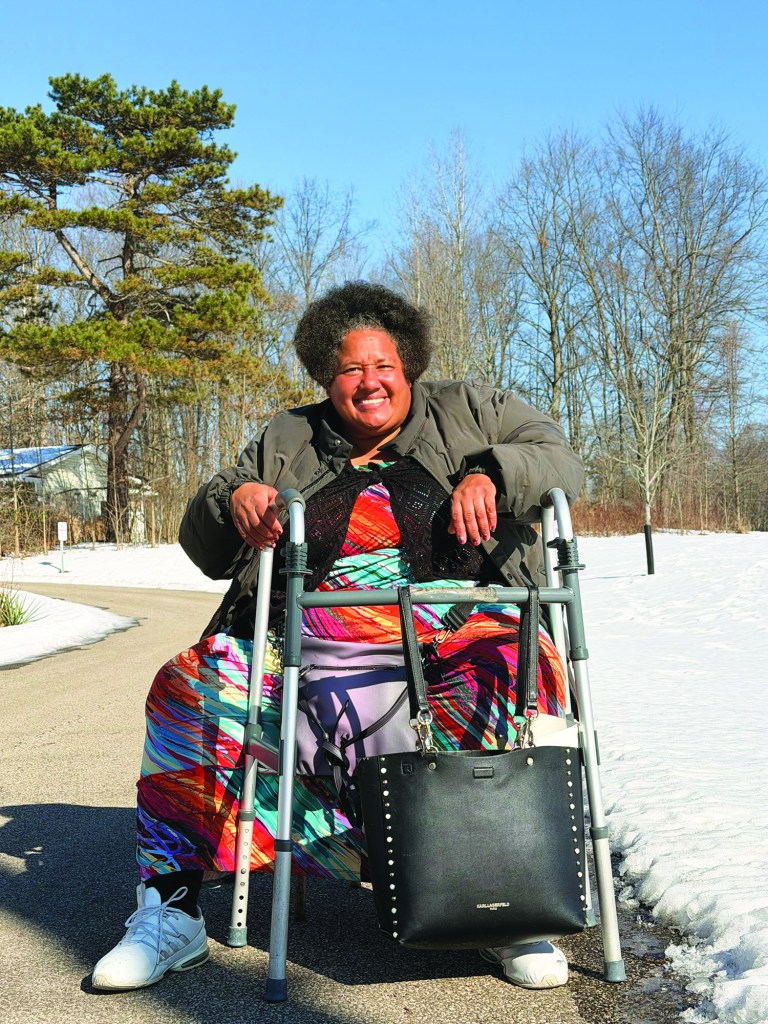
Stow legend, known to the community as the “Art Lady,” sits on Graham Road in her wheelchair nearly everyday showing drawings with a smile on her face. 

     For the past six years, the Stow community or people who happen to be driving on Graham Road after the Fishcreek intersection, see Forty-seven-year-old Shauna Pope, who sits at the base of the Adult Living Facility holding up pictures of art.

Shauna Pope sits at the base of the driveway to the Adult Living Facility on Graham Road.

     Pope grew up on the north side of Akron, moving high schools frequently from North, to central, to Wadsworth. Her high school career was filled with positivity and activity, but her life changed on a random day in 1998. 

     “I was walking down the bridge, and I got hit by a vehicle in the back of the head. I fell 150 feet off the bridge, and the cells in my head got severed,” Pope said.

     Pope was a nurse’s assistant for Valley Vue Hospital and was simply walking home, when all of a sudden this accident caused her to enter a coma for 13 days. After she woke up, Pope began seeing visions, many of which would eventually come true.

     “I saw visions in my head, and I saw where I live right now, and it’s weird because I knew I was going to live here,” Pope said. 

     Pope continues to have these visions even today, and instead of just thinking about them, she now puts them on paper.

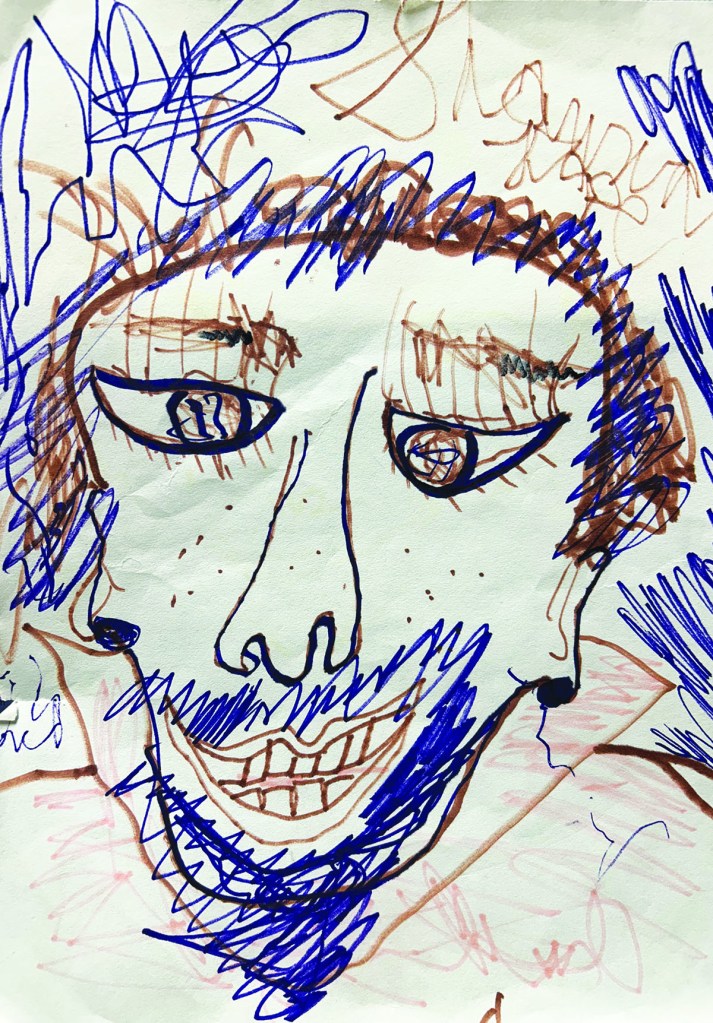
     “I see cars going by and these beautiful beautiful visions, and I just said, ‘Well, you know what? Let me copy these visions I see on paper and let me draw these people,’” Pope said.

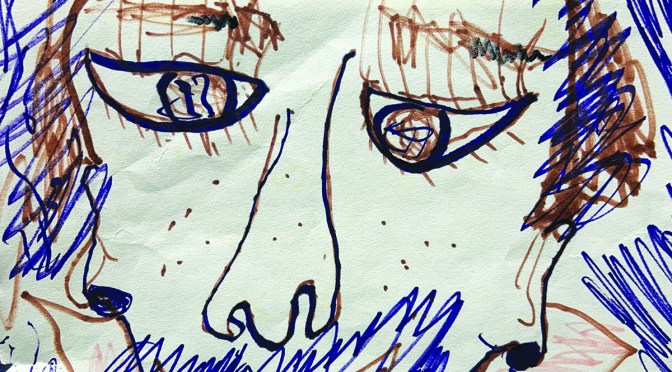
     Funny enough, these people the Pope drew, eventually started to appear in front of her. As if she was seeing the future, almost everyday people who looked very similar to the person she drew that day would come up to her.

Illustration by: Shauna Pope

     “[One time] I drew a man with purple hair with a pink, green and yellow striped shirt, and the same man walked up to me. He said, ‘This is a nice picture, but how do you know me?’ I looked at him, and I was like, ‘Whoa, what? This looks just like him,’” Pope said. “I was like, ‘Woah, I didn’t know I was drawing you.’”

     This gift Pope was given is something she believes to be truly special, and she gives God credit for her ability, believing in the philosophy: “God gave me a gift, so I’m gonna use it.”

     “God gives you certain things that help you,” Pope said. “Don’t ignore what God gives you in life.”

     Putting her faith in Christianity, Pope lives to uphold one main part of her religion from the Bible: “Love thy neighbor.” Pope upholds this value in the best way she knows how–“just smile.”

     However this was not always the case. Throughout the past six years of showing off her artwork, Pope learned just how powerful a smile really is.

     “Maybe somebody else is going through a bad time or you’re going through a bad time, too. If you smile, it’s not going to go away, but just seeing you smile, you’re going to brighten up their day,” Pope said.

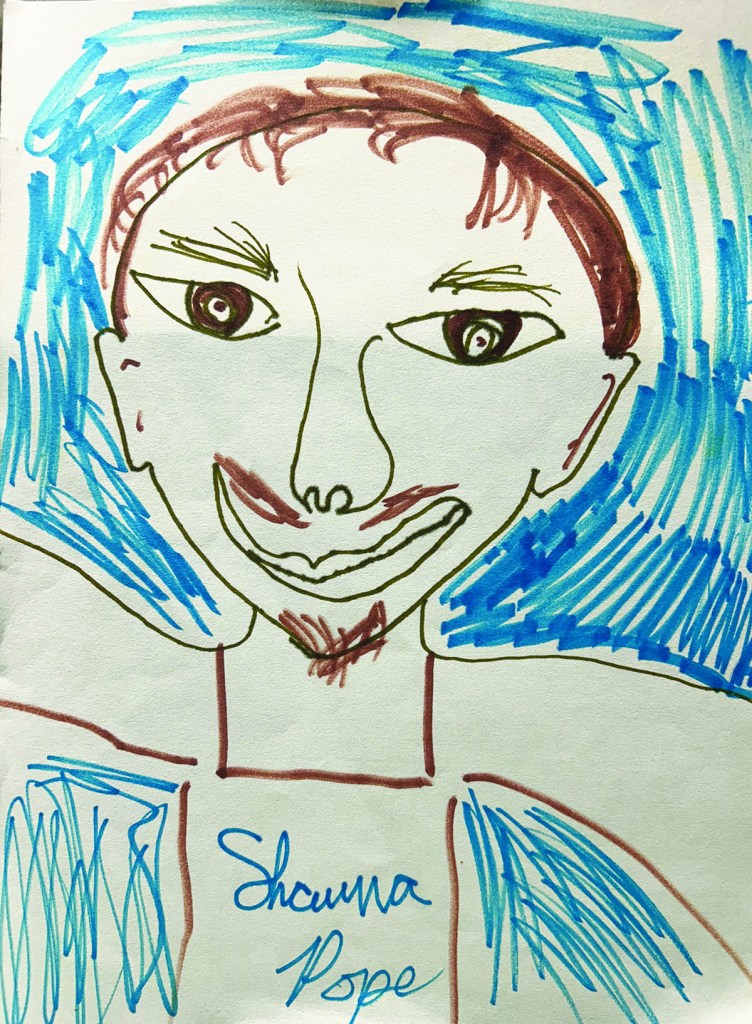
     Along with staying positive, Pope believes people are so caught up in the future that they start to forget about the present. She mentions how she will see people walking around that look like “zombies” because they are so stressed thinking about life. Pope believes this epidemic is starting to make the world a less positive place.

Illustration by: Shauna Pope

     “Everybody’s going through trouble. Everyone’s going through stress. The whole world’s not happy. The whole world’s down,” Pope said. “I just wish that people would work together. If people would just work together on things it would just make [the world] a better place.”

     In Pope’s perfect vision, she sees the world as one big amusement park where what you look like, what you wear or how you act does not matter at all. A place where everyone joins together to help each other, and where everyone “is their own president.”

     In her park, the color of someone’s skin or race they are does not matter. 

     “Who gives a whoot what color you are. I mean, just be happy with what you are and what you’re given. Life is a gift, so use it,” Pope said.

     Pope wishes for the day the world can become more together and positive as a whole. The one thing she wishes everyone would do is just simply “smile.”

     “Just smile,” Pope said. “Forget about yesterday. Forget about next year. Live for now, not in the past, not in the future but for now.”

Professional wrestling creates art through stories

By: Copper Gregg /Copy Editer

 The music industry is an ever changing landscape, fueled by constant technological advancements and means of production. Despite this continuous change, one particular method of releasing music has remained the standard: albums. 

     Years ago, the album model of releasing music just made sense. With music being exclusively physical, albums allowed listeners to purchase one vinyl, compact disc or cassette, giving them access to a good number of songs by their artist of choice.

     It also allowed artists to release a number of songs at once. Releasing one song at a time would likely not go well as people would have to buy a physical copy of each individual song. 

     Now living in a world where music is easily accessible at any time online, it is no longer “necessary” for artists to put out full albums. Musicians in the past have released singles; however, releasing an individual song has never been easier with streaming services.

     This begs the question; why are albums still so important today? 

Photo by: Copper Gregg

     Albums allow an artist to go far beyond the creativity of simply releasing individual songs. There’s so much more that goes into an album than a single which lets an artist truly make a large and meaningful work of art.

     The physical aspect of albums is also up for question as many artists to this day still release physical copies of their records. This once again allows for an immense amount of creativity from an artist.

     With modern production methods, the possibilities for unique vinyl records in particular feel nearly endless. Many artists have, and continue to do unique things to the actual disks, like different colors, printed images and patterns, zoetrope effects or different shaped vinyl altogether. The band Glass Animals, for example, released a decagon shaped pressing of  their album “ILYSFM.”

     The other reason why the physical aspect of albums is so special is the simple process of actually listening to it. By using physical media, you add an additional tactile element to the listening experience. With vinyl, there’s something almost ritualistic about putting the record on the turntable, cleaning it and placing the needle in the grooves that makes the listening experience so much more enjoyable.

     Album covers are also a massively important aspect of what makes them so special. The album cover itself can tell a story, and iconic album covers, such as Pink Floyd’s “The Dark Side of the Moon,” or Fleetwood Mac’s “Rumors,” often transcend the album itself and become culturally significant independently of the actual songs.

     One specific type of album is the pinnacle of why albums are so important and relevant to this day: concept albums.

    A concept album is when the album as a whole tells a greater story or shared theme, which allows for artists to tell a much larger and more complex story than is possible in one song. 

Photo by: Copper Gregg

     Glass Animals’ “How to Be a Human Being,” on its own is a great album that has many catchy and well-made tracks. What makes this record so special is the theming that connects all of the songs. Every song is a story that the band was told while on tour, and each song corresponds to a character displayed on the cover of the album. 

     The album would function completely fine without this added layer of story, but its addition is what makes this album have the emotion and nuance that it has. 

     Other concept albums tell one continuous story that typically follows one or multiple characters. 

     An example of this is My Chemical Romance’s “The Black Parade,” which tells the story of a man dying of cancer, reflecting on his life. 

     There is no one size fits all formula for concept albums, and it’s partially because of this fact that concept albums remain so unique and important. Each one tells its own unique story that is different from all the others. 

     The artistry and creativity facilitated by the idea of albums is justification enough for keeping them around. For musicians who care about their craft and want to express themselves and their artistic strength as much as possible, the album still reigns supreme as the way to do so.