




By: Bryanna Pullins/ Website Manager
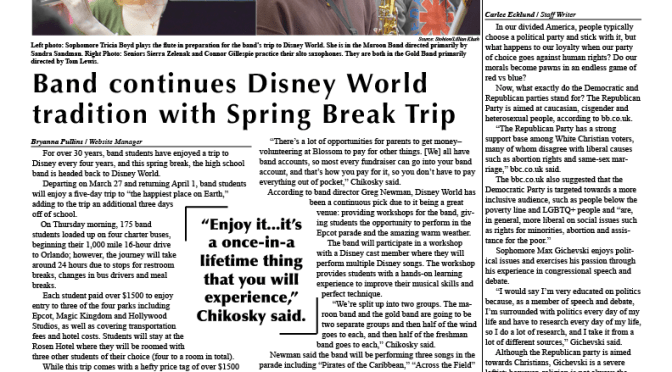
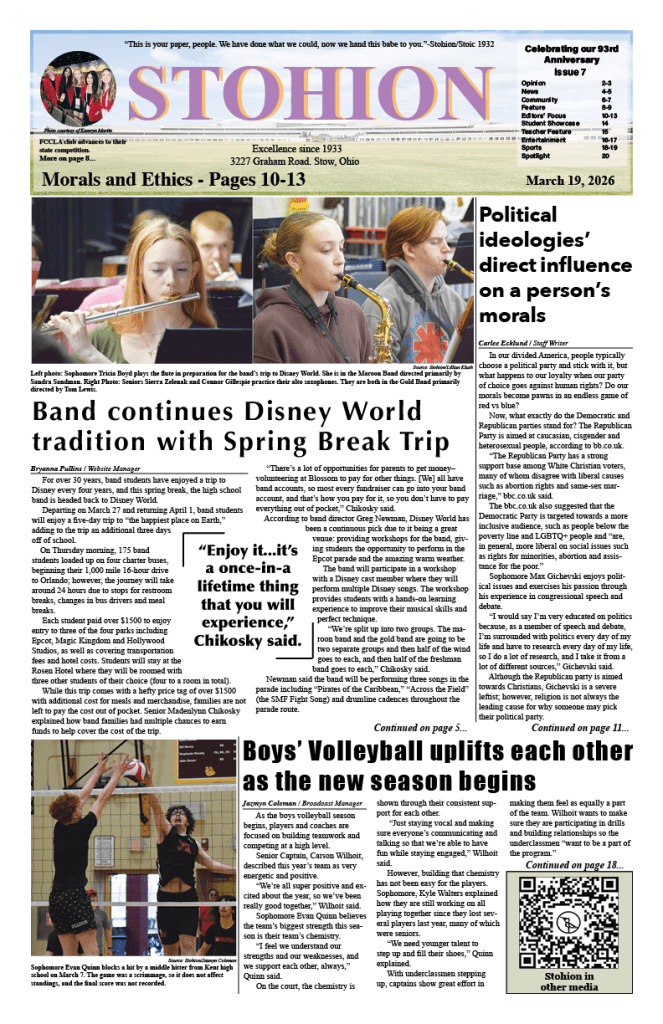
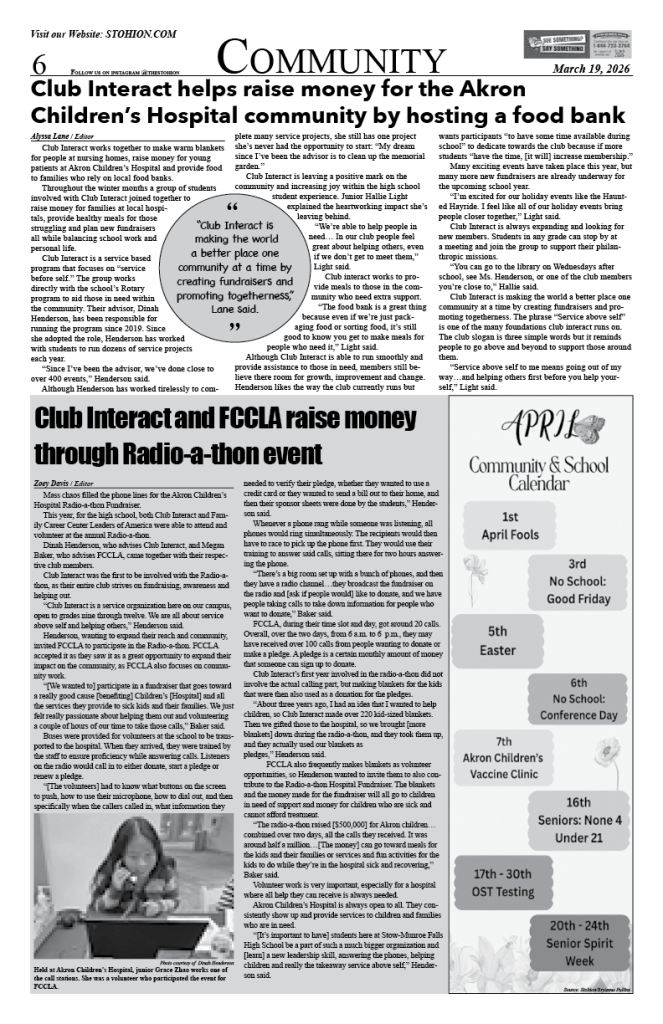
For over 30 years, band students have enjoyed a trip to Disney every four years, and this spring break, the high school band is headed back to Disney World.
Departing on March 27 and returning April 1, band students will enjoy a five-day trip to “the happiest place on Earth,” adding to the trip an additional three days off of school.
On Thursday morning, 175 band students loaded up on four charter buses, beginning their 1,000 mile 16-hour drive to Orlando; however, the journey will take around 24 hours due to stops for restroom breaks, changes in bus drivers and meal breaks.
Each student paid over $1500 to enjoy entry to three of the four parks, including Epcot, Magic Kingdom and Hollywood Studios. as well as covering transportation fees and hotel costs. Students will stay at the Rosen Hotel where they will be roomed with three other students of their choice (four to a room in total).
While this trip comes with a hefty price tag of over $1500 with additional cost for meals and merchandise, families are not left to pay the cost out of pocket. Senior Madenlynn Chikosky explained how band families had multiple chances to earn funds to help cover the cost of the trip.
“There’s a lot of opportunities for parents to get money–volunteering at Blossom to pay for other things. [We] all have band accounts, so most every fundraiser can go into your band account, and that’s how you pay for it, so you don’t have to pay everything out of pocket,” Chikosky said.
According to band director Greg Newman, Disney World has been a continuous pick due to it being a great venue: providing workshops for the band, giving students the opportunity to perform in the Epcot parade and the amazing warm weather.
The band will participate in a workshop with a Disney cast member where they will perform multiple Disney songs. The workshop provides students with a hands-on learning experience to improve their musical skills and perfect technique.
“We’re split up into two groups. The maroon band and the gold band are going to be two separate groups and then half of the wind goes to each, and then half of the freshman band goes to each,” Chikosky said.
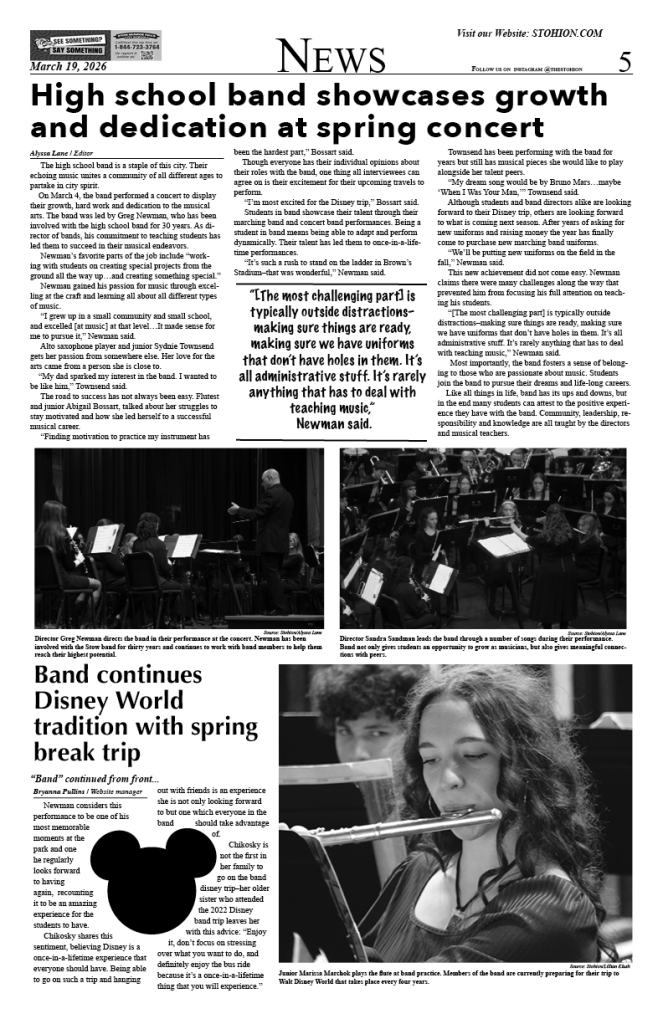
Newman said the band will be performing three songs in the parade including “Pirates of the Caribbean,” “Across the Field “(the SMF Fight Song) and drumline cadences throughout the parade route.
Newman considers this performance to be one of his most memorable moments at the park and one he regularly looks forward to having again, recounting it to be an amazing experience for the students to have.
Chikosky shares this sentiment, believing Disney is a once-in-a-lifetime experience that everyone should have. Being able to go on such a trip and hanging out with friends is an experience she is not only looking forward to but one which everyone in the band should take advantage of.
Chikosky is not the first in her family to go on the band disney trip–her older sister who attended the 2022 Disney band trip leaves her with this advice: “Enjoy it, don’t focus on stressing over what you want to do, and definitely enjoy the bus ride because it’s a once-in-a-lifetime thing that you will experience.”
By: Ty Phillips/Editor
People become victims everyday. From sexual abuse to domestic violence, there are always people who are living their worst day.
The knowledge that people have been through horrible experiences makes people morbidly curious. ‘What did they go through?’; ‘What were they thinking?’; ‘How were they treated?’ With social media people hear something terrible and have question after question.
It often seems as if people are forgetting that the “stories” they are listening to came from real people. Recently, I saw students from Central Visual and Performing Arts High School talk about their experience surviving a school shooting in 2022. Over 20 people have come forward to talk about how terrifying it was and how scared they were.
To my absolute shock, all I saw in the comments were people asking for part two, making insensitive comments and not many people giving any sympathy. Most of the comments were filled with reaction pics and “Oooooh when we gonna get the rest of the story?” as if what they were listening to was fictional and there for their entertainment.
With the Epstein files I am seeing this more and more–people feel like they should be able to know who the people are, how old they were when it happened and everything they went through. People are treating the victims like a show.
It seems as if people are quickly forgetting that what they find ‘entertaining’ is what others are having nightmares from. Amanda Knox talks about this in her article, “True crime fails when it treats trauma as entertainment. But there’s a better way.” She discusses how society finds brutal murders and true crime to be the peak of their interest without taking into account that it actually happened to someone.
While morbid curiosity is normal and important, there becomes a point where it becomes insensitive and rude. Sharing photos of crime scenes and un-blurring photos of the children in the Epstein files is not acceptable or normal. Treating victims with the respect they deserve is happening less and less; They are becoming spectacles for people to talk about.
Many articles are being written, and there are photos shown of things that victims had to go through, yet it seems as if people are not focusing on the victims themselves but the circumstances and the monstrosities they went through.
Documentaries are often made about what victims went through. A newer one is Piper Rockelle and what she went through with childhood exploitation and how terribly her mother treated her. While it was airing, people on her TikTok had very little empathy, leaving comments like, ‘Yes, but did she have to do…..” or “Do you guys think she acts like this because her mom made her?” When Rockelle would come on social media and talk about how the documentary–which was made without her consent–affected her, people told her to move on and to just answer their questions.
Social media and TV are heavily adding to people’s greed to know what people have been through, desensitizing them to the fact that they have no right to know how people have lived.
The Epstein files have left people with many questions. Something I am seeing often asked is why are victims being unblurred, but the perpetrators are being hidden? This leads to more questions about the victims, trying to find them and trying to see if there was anyone who loosely looked like them hanging around celebrities.
People are reading what victims had to go through and being disgusted, yet they continue to share it and investigate more. Even when victims of Epstein and similar events come out and ask people to be kinder, not to talk about them like they are a spectacle and give them the respect they deserve, people continue on to act as they did previously.
Morbid curiosity is fine, but think about what if one day your family had a horrid murder or attack, and before people ask how you are feeling or what they can do to help, they are sharing all of your private information for everyone to know without asking you for as little as an okay. How would that make you feel? Be considerate and respectful when listening and learning about what people have gone through. `
By Carlee Ecklund/Staff Writer
“A medium-sized data center can consume up to roughly 110 million gallons of water per year for cooling purposes, equivalent to the annual water usage of approximately 1,000 households,” according to the Earth Space Sustainability Initiative website.
The AI hardware chips, or GPUs, are stored in data centers and are cooled down. Because the GPUs get so hot, water is used to keep them from overheating.
“A single chip installed in a data center has already consumed thousands of gallons of water by the time it reaches the site,” essi.org said.
Most of Earth’s surface is water, so why is it an issue that AI uses it to cool down? Well, not all of Earth’s water is drinkable, and AI uses clean drinking water to prevent overheating.
“Only 3% of Earth’s water is freshwater, and only 0.5% of all water is accessible and safe for human consumption,” essi.org said.
A significant portion of clean water is not readily available for our consumption. Much of our freshwater is stored in glaciers.
“About 2.1% of all of Earth’s water is frozen in glaciers,” usgs.gov said.
Data centers also use air for cooling GPUs, although water is a popular alternative. Over time, water usage may increase, potentially leading to a higher supply than demand.
“Free cooling is a method where outside cold air is drawn into the data center to cool the equipment. Data centers must be located in cooler climates for this strategy to be effective,” essi.org said.
Sophomore Pranita Adhikari strongly opposes the use of AI and thinks that it harms one’s mind.
“[People] can lose the ability to think for themselves, and some can’t fathom the idea of forming a coherent thought on their own,” Adhikari said.
Junior Lilliana Kauffman does condone the use of AI; she claims it is incredibly helpful for her academics.
“If it’s just harder for me to get a rough idea of what I am supposed to do for assignments, I will have AI clarify for me,” Kauffman said.
Both students have different views on the use of AI; however, both agree teachers should not be allowed to use it for assignments.
“The amount of AI they use to make certain assignments or certain study tools, everybody thinks it’s not that much, but within how much people use it, saying ‘it’s not that much’ that builds up eventually,” Adhikari said, suggesting that even small inputs of AI can accumulate significantly over time. This perspective aligns with Kauffman’s view, who argues the same standpoint.
“They shouldn’t be allowed because we’re not really allowed to use AI, and a lot of the time the AI doesn’t like to correctly project what they’ve taught us in class with their own voices,” Kauffman said.
The debate about whether AI enhances or reduces people’s intelligence is difficult to determine.
“I think if you use it for everything, it makes you really ignorant. It really hurts your critical thinking skills, and it makes you lose the ability to form thoughts or ideas without using another device,” Adhikari said.
Everyone has different reasons why they use AI or why they should be against it.
“Our planet’s going to be done one way or another, so it’s just kind of like if it’s helping me, then why not?” Kauffman said.
AI is very prominently represented in today’s society and is used as a replacement for many human roles like art, music, literature and more. This raises a question: which is better?
“I don’t think it’s as efficient as manmade things because it takes the surface-level idea of it and makes it into whatever it can. Man-made things are more authentic,” Adhikari said.
Kauffman often disagrees and argues that AI creations are actually of higher quality.
“I think that a lot of things that AI does are actually more efficient because it takes less time,” Kauffman said. “It’s faster, and it’s smarter than humans are.”
The amount of water required for AI to perform even the simplest tasks is incredibly wasteful.
“A mid-sized data center consumes as much water as a small town, while larger ones require up to 5 million gallons of water every day—as much as a city of 50,000 people,” lincolninst.edu said.
The discussion around AI portrays the tension between technological advancements, environmental sustainability and differing views on intelligence. While concerns about water usage are valid, the potential benefits of AI should also be considered.
Opinions on this topic vary widely regarding how technology influences our creativity and cognitive skills.
Finding a balance between embracing innovation and preserving our essential resources will be very important as we navigate through AI and its future role in our society.
 SEE SOMETHING, SAY SOMETHING--Anyone can call the tip line: 1-844-723-3764 or email safehs@smfschools.org