
All posts by haileysanford

Speaker shares her story with juniors and seniors

     Life includes numerous challenges for nearly everyone. 

     Aleanya Moore has experienced and overcome such challenges: having a mother addicted to drugs, growing up without a father and having an overall lack of foundation for her future. Moore was able to move past her complications to graduate college and gain her master’s degree, create a foundation to mentor young girls, join Delta Sigma Theta Sorority inc and win Ms. Black Midwest USA.

     Moore spoke to juniors and seniors on Feb. 16 during the school day about their futures in college or other avenues. She gave advice, spoke of her struggles and explained how she was able to persevere and create a positive life for herself and her daughter.

     Moore grew up with her grandmother as her guardian because her mother had a drug addiction, and her father was not present. She explained the lack of support led to not having “the social and emotional support I needed as a child.”

     When Moore was in high school, she had a 1.7 GPA and was not very dedicated to her studies. She kept her grades up to participate in Basketball and Track. When it came to attending university, many colleges did not accept her because of her GPA.

     Moore was accepted into the University of Cincinnati on academic probation. She had to receive a 2.0 during her first quarter; otherwise, she would be sent away. She achieved this feat and graduated from college after five years.

     She warned against ignoring academic responsibilities when attending college. She had seen people around her, including her roommate, fail out of college.

     “Many people got to campus and partied it up, and they failed. They flunked out of college,” Moore explained.

     Moore emphasized the importance of not letting certain events define who you are. She explained that despite her challenging childhood, she was able to create success for herself.

     Being the first person in her family to attend college, Moore felt she was taking her destiny into her own hands. 

     “I’m the person that can change the trajectory of my bloodline,” Moore said.

     Many people fear the shift from high school to college, and Moore acknowledged that the change can be a scary experience. She also spoke on how failure is not as common as many think.

     “If you fall and get back up, that’s not failure,” Moore stated.

     Moore warned against going into a career field based solely on income. She admitted that numerous people around her did not think of their passions when choosing their career. Moore chose to be an educator because she was passionate about it, and she is currently the dean of students at a charter school in Indianapolis.

     “I love what I do to the point that if I didn’t get paid, it would still be an honor to me,” Moore said.

     Moore explained that even if the students were unsure of what they were passionate about, they could take general classes to prepare themselves for the other classes they would need to take for their major. She also recommended that each person find a mentor in their chosen field of study and learn from them.

     Along with following passions, Moore encourages students to think of what truly speaks to them and not what their parents want from them. 

      “Sometimes what you want to do may go against your parent’s views and goals,” Moore stated.

     Moore divides her life into chapters, and she gives each chapter of her life a title: high school was endurance, college was assigned tenacity and her 2007 chapter was titled courageousness.

     She invited students to the stage to speak of what chapter they are currently experiencing.


Source: Stohion/Hailey Sanford
Aleayna Moore spoke to juniors and seniors on Feb. 16 to prepare them for college; she spoke of the different chapters in her life. She encouraged students to share what chapter they are currently experiencing with the rest of the auditorium.

     Senior Noah Brown explained he is in his transition chapter: “Before coming to Stow, I was in a not-so-great area.”

     Brown discussed how he is doing better now that he is experiencing this chapter. Other students described their chapters of learning, healing, perseverance and sisterhood. Each student is experiencing different things, this is evident through their chapter titles.

     Moore was able to become something she never thought possible. When she was in high school, she had no belief in herself, but she transformed her struggles into something greater, something that helped her overcome her complications.

     Moore is currently a PhD student and will compete for Ms. Black USA in August. She has also written four books. Her accomplishments are impressive, and she would have been unable to achieve them without believing in herself.

     Moore left the students with a piece of advice: “Don’t be afraid to be the eagle that is going to soar over others.”
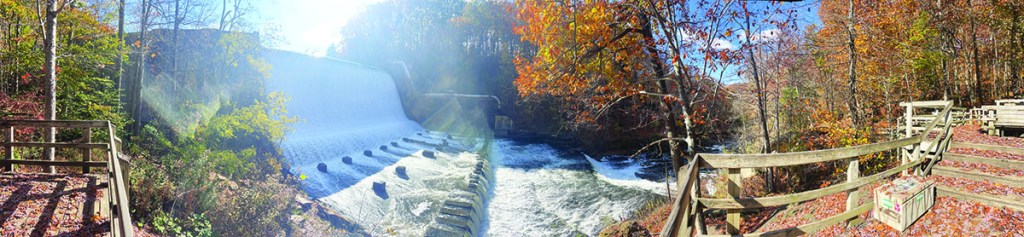
Practice and Patience: Gorge Dam to be removed after 65 years of being inactive

     Gorge Metropark in Cuyahoga Falls is home to the massive dam that once powered energy for street cars and lights. There are plans to remove the dam, and during the process, the park will be closed to the public.

     Formed by retreating glaciers, the gorge has jagged rocks and edges, hiking trails and much more to offer visitors. People have been visiting the 155-acre park for over 150 years.

     Put up in 1911, the dam powered parts of Cuyahoga Falls for 47 years before it was shut down in 1958. The dam has collected a lot of sediment through the years, the sediment contains numerous hazardous materials: industrial products, chemicals, heavy metals and grease.   There are currently about 900,000 cubic yards of sediment, at certain areas, the sediment can reach about 34 feet deep.

Source: Stohion/Hailey Sanford
There is an overlook at Gorge Metropark viewing the falls. Once the dam is removed, the entire landscape of the falls will be different and there is no telling what the falls will look like.

     Many people have been involved in getting the project to take off, the planning began in the mid-2000s and has been worked on ever since. The United States Environmental Protection Agency(USEPA), Ohio Environmental Protection Agency(EPA), the City of Akron, Summit Metroparks, the City of Cuyahoga Falls, Summit County, First Energy and Northeast Ohio Regional Sewer District are partners in the project. Many people also helped by “lobbying the EPA, our federal representatives and the White House to put this on the high list of projects,” Mayor of Akron, Daniel Horrigan stated.

     This dam removal has been a long time in the making, many years of planning have been put into the project to bring it to where it is today.

     “This project is one that involves patience and partners. Years and years ago this was talked about, ‘Wouldn’t it be wonderful to remove dams on the Cuyahoga River and other rivers across the state to restore free-flowing condition,’” Bill Zawiski, water quality supervisor for the Ohio EPA said.

     Many other dams in the Cuyahoga River have been removed, and when the Gorge dam is removed, the Cuyahoga River will be completely free-flowing from Kent to Lake Erie.

     There are two parts to the gorge removal: removal of the sediment–headed by Courtney Winter of the

USEPA–and the actual dam removal–headed by Heather Ullinger, the Akron city project manager.

     Removing the dam would not be possible without removing the majority of the sediment prior because the hazardous material would flow into further parts of the river and end up in Lake Erie.

     For about a mile and a half upstream of the dam, the sediment thickness ranges from 1 foot to 34 feet deep.

Source: Stohion/Hailey Sanford
The dam pool goes from about a mile and a half upstream the dam to the dam. In this area, sediment ranges from 1 foot to 34 feet deep: the sediment in this area is harmful to the environment and people.

     Within the sediment, there are health risks; however, the level of danger is not high enough to be categorized as hazardous material, making it easier to deal with for the EPA.

     “The contaminants are at a level at which we need to address them and dispose of them to remove that human health risk, as well as risk to fish and wildlife populations, but the good news is that they’re not at as high of a level where it’s necessary for us to categorize them as a hazardous waste or waste that needs to be treated under [Toxic Substances Control Act] or [Resource Conservation and Recovery Act] which are regulatory programs,” Winter explained.

     Sediment will be removed from the river bucket by bucket; put on a barge that will take it to the staging area, by the old power plant; sent through temporary pipelines, where the sediment will be mixed with cement, to Cascades Metropark and placed in the park before the landscape is reshaped by bulldozers to mimic the natural land. The cement-sediment mixture will have soil placed over it and native trees and vegetation will be planted on top of it in the future.

     Project planners are being cognizant of the noise levels of the pumps taking the sediment about two miles to Cascade Park.

     Placing the pumps spread out from each other will eliminate part of the noise issue, “We can hopefully avoid where placing them where it could potentially be a nuisance to folks that are living close,” Winter said.

     There are no concerns about placing the contaminated sediment in another location, as it would be more harmful for it to remain in the river. Furthermore, the area in Cascades Park where the sediment mixture will be placed will be closed off to the public: no trails will go over the mound.

     “We’re adding that cement in the other additives, it’s actually binding to the contaminants itself and there have been studies that have looked at leachate testing to look to see rainfall or groundwater flow if there’s potential for any of the contaminants to potentially migrate once they’re in there, and all of that has determined that it is safe,” Winter explained.

     Sediment removal is to take place over two construction seasons: 2024 and 2025. The remedial project is planned to be completed in the winter of 2025-2026, and the dam removal will begin in 2026.

Source: Stohion/Hailey Sanford
The dam can be seen from trails in the Metropark. The trails and Metropark as a whole will be closed during construction.

     Removing the dam will cause an increased flow of water to the river, removing the dam all at once could be detrimental to the environment and animals in the area.

     “The other thing that we have to accommodate is [Ohio Department of Natural Resources] is requiring us to meet a draw-down limit of one-foot-per-week, so we can only lower the water level one foot per week,” Ullinger said.

     To follow the one-foot-per-week requirement, there are plans to utilize siphons to reduce the water level weekly. 

     There are five segments to the dam removal, each time the dam is removed, the siphons will be replaced, but when the fifth sequence comes, there will no longer be a use for siphons.

     In total, the water level will be reduced by 40 feet, which causes concerns for the river bank and the Front Street Bridge. The team is going to keep a close watch on the riverbank as well as the Front Street Bridge to ensure no stabilization is required.

     October 25 marked the signing of the project agreement allowing the removal to move forward.

     “I am wearing my ‘When Pigs Fly’ socks because Steve Tuckerman and Bob Wisinski, the folks that mentored me, that would have been their answer had we asked this question 30 years ago,” Zawiski stated. “It is amazing to think of the work that has been done, it is even more amazing to think of the work that will be done and all the support that folks have given us to encourage this project to move forward to restore the Cuyahoga River to what was once the most visited place as a natural area in the state of Ohio.”