
Gorge Metropark in Cuyahoga Falls is home to the massive dam that once powered energy for street cars and lights. There are plans to remove the dam, and during the process, the park will be closed to the public.
Formed by retreating glaciers, the gorge has jagged rocks and edges, hiking trails and much more to offer visitors. People have been visiting the 155-acre park for over 150 years.
Put up in 1911, the dam powered parts of Cuyahoga Falls for 47 years before it was shut down in 1958. The dam has collected a lot of sediment through the years, the sediment contains numerous hazardous materials: industrial products, chemicals, heavy metals and grease. There are currently about 900,000 cubic yards of sediment, at certain areas, the sediment can reach about 34 feet deep.
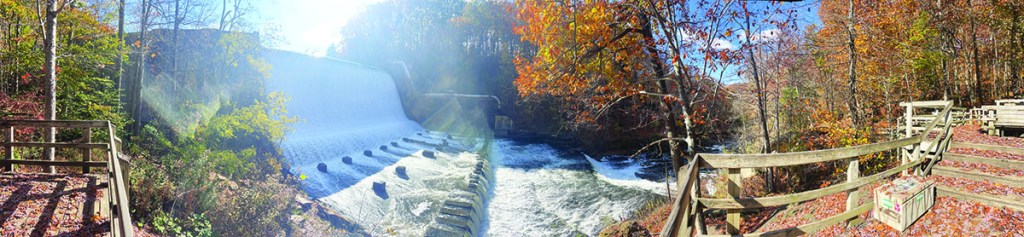
There is an overlook at Gorge Metropark viewing the falls. Once the dam is removed, the entire landscape of the falls will be different and there is no telling what the falls will look like.
Many people have been involved in getting the project to take off, the planning began in the mid-2000s and has been worked on ever since. The United States Environmental Protection Agency(USEPA), Ohio Environmental Protection Agency(EPA), the City of Akron, Summit Metroparks, the City of Cuyahoga Falls, Summit County, First Energy and Northeast Ohio Regional Sewer District are partners in the project. Many people also helped by “lobbying the EPA, our federal representatives and the White House to put this on the high list of projects,” Mayor of Akron, Daniel Horrigan stated.
This dam removal has been a long time in the making, many years of planning have been put into the project to bring it to where it is today.
“This project is one that involves patience and partners. Years and years ago this was talked about, ‘Wouldn’t it be wonderful to remove dams on the Cuyahoga River and other rivers across the state to restore free-flowing condition,’” Bill Zawiski, water quality supervisor for the Ohio EPA said.
Many other dams in the Cuyahoga River have been removed, and when the Gorge dam is removed, the Cuyahoga River will be completely free-flowing from Kent to Lake Erie.
There are two parts to the gorge removal: removal of the sediment–headed by Courtney Winter of the
USEPA–and the actual dam removal–headed by Heather Ullinger, the Akron city project manager.
Removing the dam would not be possible without removing the majority of the sediment prior because the hazardous material would flow into further parts of the river and end up in Lake Erie.
For about a mile and a half upstream of the dam, the sediment thickness ranges from 1 foot to 34 feet deep.

The dam pool goes from about a mile and a half upstream the dam to the dam. In this area, sediment ranges from 1 foot to 34 feet deep: the sediment in this area is harmful to the environment and people.
Within the sediment, there are health risks; however, the level of danger is not high enough to be categorized as hazardous material, making it easier to deal with for the EPA.
“The contaminants are at a level at which we need to address them and dispose of them to remove that human health risk, as well as risk to fish and wildlife populations, but the good news is that they’re not at as high of a level where it’s necessary for us to categorize them as a hazardous waste or waste that needs to be treated under [Toxic Substances Control Act] or [Resource Conservation and Recovery Act] which are regulatory programs,” Winter explained.
Sediment will be removed from the river bucket by bucket; put on a barge that will take it to the staging area, by the old power plant; sent through temporary pipelines, where the sediment will be mixed with cement, to Cascades Metropark and placed in the park before the landscape is reshaped by bulldozers to mimic the natural land. The cement-sediment mixture will have soil placed over it and native trees and vegetation will be planted on top of it in the future.
Project planners are being cognizant of the noise levels of the pumps taking the sediment about two miles to Cascade Park.
Placing the pumps spread out from each other will eliminate part of the noise issue, “We can hopefully avoid where placing them where it could potentially be a nuisance to folks that are living close,” Winter said.
There are no concerns about placing the contaminated sediment in another location, as it would be more harmful for it to remain in the river. Furthermore, the area in Cascades Park where the sediment mixture will be placed will be closed off to the public: no trails will go over the mound.
“We’re adding that cement in the other additives, it’s actually binding to the contaminants itself and there have been studies that have looked at leachate testing to look to see rainfall or groundwater flow if there’s potential for any of the contaminants to potentially migrate once they’re in there, and all of that has determined that it is safe,” Winter explained.
Sediment removal is to take place over two construction seasons: 2024 and 2025. The remedial project is planned to be completed in the winter of 2025-2026, and the dam removal will begin in 2026.

The dam can be seen from trails in the Metropark. The trails and Metropark as a whole will be closed during construction.
Removing the dam will cause an increased flow of water to the river, removing the dam all at once could be detrimental to the environment and animals in the area.
“The other thing that we have to accommodate is [Ohio Department of Natural Resources] is requiring us to meet a draw-down limit of one-foot-per-week, so we can only lower the water level one foot per week,” Ullinger said.
To follow the one-foot-per-week requirement, there are plans to utilize siphons to reduce the water level weekly.
There are five segments to the dam removal, each time the dam is removed, the siphons will be replaced, but when the fifth sequence comes, there will no longer be a use for siphons.
In total, the water level will be reduced by 40 feet, which causes concerns for the river bank and the Front Street Bridge. The team is going to keep a close watch on the riverbank as well as the Front Street Bridge to ensure no stabilization is required.
October 25 marked the signing of the project agreement allowing the removal to move forward.
“I am wearing my ‘When Pigs Fly’ socks because Steve Tuckerman and Bob Wisinski, the folks that mentored me, that would have been their answer had we asked this question 30 years ago,” Zawiski stated. “It is amazing to think of the work that has been done, it is even more amazing to think of the work that will be done and all the support that folks have given us to encourage this project to move forward to restore the Cuyahoga River to what was once the most visited place as a natural area in the state of Ohio.”
 SEE SOMETHING, SAY SOMETHING--Anyone can call the tip line: 1-844-723-3764 or email safehs@smfschools.org